
Most explanations of financial domination (findom) and financial submission are written by people who researched it for an afternoon. They reach for the obvious frameworks: addiction, compulsion, low self-esteem. Their conclusions sound clinical while bypassing anything interesting or real. After fifteen years of practice, an academic background in psychology, and first-hand experience with numerous financial domination dynamics that have lasted a decade or longer, I find those explanations not just incomplete but mostly wrong.
What actually drives financial submission is more precise, more interesting, and more coherent than what you will find with a cursory google search. First you need to stop thinking about money as an object and start thinking about it as what it actually is: power.
Money is part of financial submission. Power is the rest.
In a capitalist society, money is the most legible form of power most people hold. It determines what you can access, what you can refuse, what futures open up to you. It fuels your ability to remake your own reality.
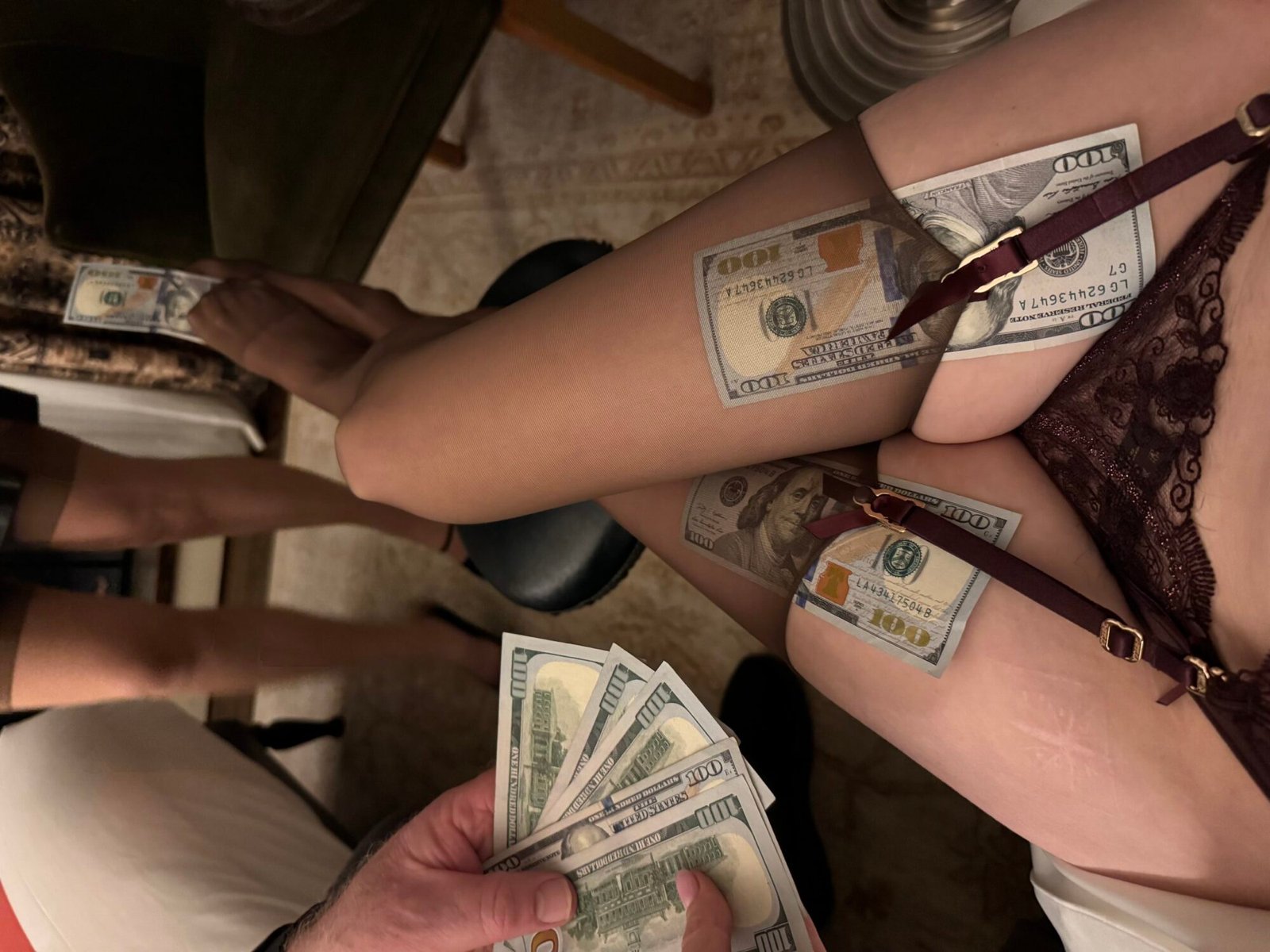
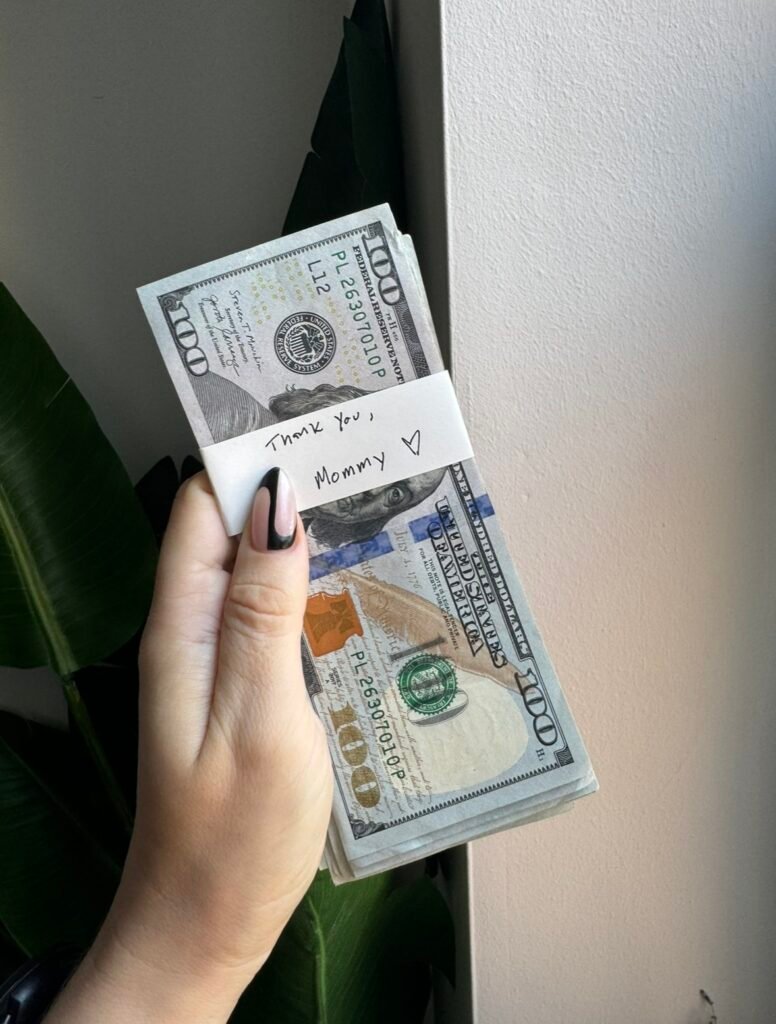
When a financial submissive sends a tribute, they are not giving away currency. They are surrendering a unit of autonomy. This surrender is deliberate. It is consensual. And it is fucking hot. The charge of that act comes not solely from the money itself but from what the money represents: real power, genuinely transferred, right into my perfectly manicured hands.
This is why financial domination, fully developed, produces something most other forms of power exchange cannot. Physical submission ends when the scene ends, but financial submission leaves a mark in the real world. It’s tangible: a bank statement, a depleted account, a credit card surrendered indefinitely, or the thrill of a notification letting you know you’ve been tapped. Similar to long-term chastity or wearing a collar 24/7, the erotic transfer can happen outside the container of a session, in the same arena where everything else in your life takes place. That is what makes it hit differently. What makes it so charged.
I think about this through the lens of capital. Money is the purest distillation of what we exchange for power in the world we actually inhabit. Financial domination does not merely play with power. It literally transfers it.
A note on gender: findom and financial submission is not inherently gendered
Before going further, let me say one thing clearly. Financial domination is not a strictly gendered practice, and I play with people of all genders. The psychology I am describing here is not exclusive to men. I have a long-term woman finsub whose dynamic with me has evolved over many years, and some of my most compelling findom-adjacent relationships have been with people who do not fit the demographic most commonly associated with this kink.
That said, the majority of financial submissives are men, and specifically men with access to disposable income. This is not coincidental. It is structural. We live inside a hetero-capitalist patriarchy in which men, particularly professional high-earning men, have historically held disproportionate access to capital. Financial domination inverts that structure, so that a man surrenders the one thing that most concretely represents his power in the world, to a woman who takes it on her own terms. The eroticism of that inversion cannot be separated from the social context that makes it an inversion in the first place.
For people who do not move through the world as high-earning men, the dynamic takes a different shape. Exploring findom across genders fascinates me. The psychology is the same. The social stakes are different. The erotic charge shifts. The desire for control, sacrifice, and surrender remain. It is also why I adore financial domination in the context of a long term relationship.
The two types of financial submissives
Over the last fifteen years, I have encountered two meaningfully different psychological profiles in financial submission. They are sometimes conflated. Conflating them leads to mismatched dynamics and a great deal of dissatisfaction for all involved.
The first type experiences financial submission as an acute event. They revel in the act of sending, the moment of clicking, a handing over cash, or seeing their account balance dwindle. It produces an altered state, one connected more to the psychology of gambling than to the psychology of devotion. It is an adrenaline spike, a kind of flow. They experience a brief and complete suspension of ordinary consciousness. These are the people I think of as pay pigs. They orbit, disappear after achieving this high, and return when they are ready to seek it again. The drain is the point. What comes after is not.
The second type experiences financial submission as an ongoing structure. For them, the erotic charge is not the acute moment of sending (though this can still definitely be charged) but the sustained condition of having surrendered control. Every budget decision made in deference to a dominant woman is an act of submission. Every paycheck that flows toward her account is a renewal of that commitment. The money itself flows from submissive to dominant, and creates the architecture of sustained surrender.
The point is to transfer power, to surrender one’s will to one’s dominant, to prioritize one’s Mistress’ pleasure above that of their own. These are financial submissives in the fuller sense, people for whom the dynamic does not end between sessions because there are no sessions. There is only the relationship. There is only ongoing commitment and deeper servitude. A send is a flirtation. It is only the beginning.
Both are real. But they are not the same thing, and knowing which one you are matters enormously for what kind of dynamic will actually satisfy you. I work with both, in different capacities, and with very different expectations of each. If you are trying to figure out which describes you more accurately, my post on the difference between pay pigs and financial submissives is a useful place to start.
Why high-achieving men desire financial submission
I love excavating the psychology of financial submission in high-functioning, high-earning men. Though the desire is certainly not exclusive to this category of people, wealth accumulation, especially amongst men who have shifted class position with age, certainly plays a role. So what do they get out of surrendering their wealth to me? The writing I have seen on this topic almost never gets it right.
Some men hold significant professional power. They manage people, control budgets, and carry real decision-making responsibility. The ones who arrive at financial submission tend to do so through a specific and recognizable path. They have spent years being in control. They are good at it. Then somewhere along the way they discovered that what they want most of all is to be relieved of it. Not in a way that destabilizes their external life, but in a way that is real enough to actually work. I have found that most people moving through the ins and outs of capitalism face a certain degree of burnout and decision fatigue that makes surrendering to the right person and letting them take control to be a relief.
Financial submission relieves their burden in a way most other forms of submission cannot. It is concrete. It is ongoing. It adds meaning and purpose to their labor. They now work for Mistress Blunt. They sacrifice for Mistress Blunt. It does not even require them to share a room with me to feel the shape of the dynamic. They see the money leaving their account on a schedule they accepted. Or they plan how to spend the allowance I granted them. Or they make a purchase only after asking my permission. These are real events in their actual life, not a fantasy they inhabit behind a closed door, only for the duration of a session they will leave behind.
What I observe, consistently, is that submission is more satisfying when it costs something real. A tribute that requires no sacrifice doesn’t move me, and it doesn’t move anything within the submissive. A transfer of something genuinely held is the entire point. Much like with a corporeal scene, most people want to FEEL something. They want it to actually hurt. They want to be transported, held, and seen in their sacrifice and submission.
Of course, this dynamic has a political dimension. My essay on financial domination and the politics of women taking money explores it in much more depth. In short, there is a specific charge when a man who holds significant structural power in the world chooses to surrender its most tangible expression to a woman who takes it entirely on her own terms. That charge is not incidental to the psychology. It is central to it.

The role of shame in findom
Financial submission carries a particular social prohibition. Men are warned, in no uncertain terms, against women who are “after their money”. They must remain wary of manipulation, avoid being taken advantage of, and regard financial generosity as a vulnerability that can be exploited. The cultural message is consistent: guard your resources and be suspicious of any woman who wants access to them.
Financial domination harnesses that fear and fucks with it. The man who spent his whole life guarding his wallet finds that surrendering it instead, to the right person and on the right terms, produces a profound sense of release, one he has not found anywhere else. The shame is part of the charge and the transgression is the point. Intentionally playing with shame and transgression can lead to profound transformation
As a practicing findomme I relish seeing what happens to that shame over time in a long-term dynamic. I witness a transformation. The person who arrived with their desire tangled up in embarrassment, who found a forbidden thrill in the act of sending, often arrives months or years into a well-built dynamic at an entirely different place. Placing their wealth at my feet does not feel shameful at all. It feels like the most honest thing they do.
The man who once felt ashamed of his desires, told by society that he must maintain his power to maintain control of a woman may learn the power of surrender. He may even learn that the fear he has been holding on to was holding him back from a relationship where he is able to truly share. A relationship where he is able to be generous with all parts of himself and receive the benefits of worshiping a woman who is spoiled and at ease in her life.
The shame is not the goal. It is the material you start with. It is the material of transformative bliss.
What this means for how I cultivate financial submission and findom dynamics
Psychological domination is always at the core of my work. I curate a blueprint of how someone’s mind works and use that knowledge as my primary instrument of control. Financial submission, at its most developed, is a psychological practice more than a financial one. It restructures how someone thinks about their own resources, their own autonomy, and their own priorities.
Every dollar that flows toward me is a small act of reorienting your entire life around someone else’s pleasure rather than your own. Through sacrifice you learn that there is no greater pleasure than facilitating mine.
That reorientation, sustained over time, is what produces the dynamics I find genuinely compelling. This is the architecture we build for your ongoing surrender.
If you want to see how this looks like in practice, my long-term findom dynamic post goes into considerable detail. The interview with my woman finsub shows what it looks like from the submissive’s side over years, in a dynamic that has evolved well beyond its starting point.
And if financial domination is not what you seek, but something in how I think about power interests you, my practice is considerably wider than the exclusively findom content suggests.